
How many days of oxygen backup does a hospital need? The honest answer is that no single number suits every hospital.
MGPS redundancy requirements depend on your bed load, peak oxygen flow rate, tanker delay history, and local refill lead time. A hospital near a reliable oxygen filling station can work with a different oxygen reserve capacity than a hospital that faces monsoon disruption, remote access roads, or delayed tanker movement.
That is why we do not size hospital oxygen backup from an average figure alone. We look at the real situation on your site, including peak concurrent demand, ICU count, ventilator load, OT schedule, and the time it takes for your supplier to reach your gate.
This matters even more in 2026. ISO 7396-1 is moving towards its next edition, so hospitals should check the applicable edition and project specification before finalising an MGPS design.
What the Main Standards Actually Say
The standards set the safety structure. They do not give every hospital one fixed day-count.
| Standard or guidance | What your team should check |
| ISO 7396-1:2016 | Requires reliable source arrangements for a medical gas pipeline system, but does not give one universal number of backup days. |
| HTM 02-01 | Health Technical Memorandum 02-01 covers safe MGPS design and operation. Project specifications may refer to an emergency reserve manifold with 4 hours of operation. |
| NFPA 99 (2021) | Where this code applies, confirm the adopted edition and authority requirements. Some specifications refer to a reserve tank holding a 24-hour supply, calculated at maximum flow rates. |
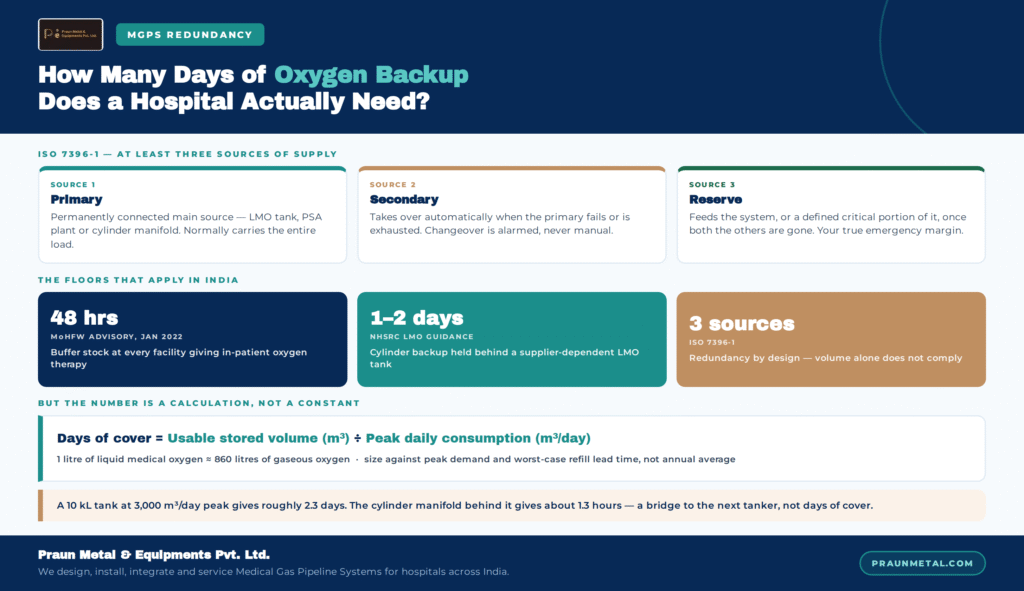
| NHSRC | NHSRC guidance identifies 1 to 2 days of cylinder backup as best practice for LMO-supported hospitals. |
| Site-specific design | Many suppliers use a 48-hour minimum reserve or a 2-week supply in the liquid medical oxygen (LMO) tank, but the right capacity must follow your actual risk. |
The key point is simple. The documents guide the architecture, while your hospital decides the duration from its real supply chain.
Why Redundancy Needs Three Separate Sources
A safe medical gas pipeline system should not depend on one oxygen source. You need three sources of supply, with three independent sources arranged so that each one must meet full demand on its own.
That structure protects patients from a single point of failure.
- The primary source of supply carries normal hospital demand. It is often a liquid medical oxygen (LMO) tank with a vacuum insulated evaporator (VIE), or a PSA oxygen generator where tanker access is not reliable.
- The secondary source of supply takes over when the main source drops or requires maintenance. In many hospitals, this is an automatic changeover manifold connected to a cylinder bank of D-type jumbo cylinders.
- The reserve source of supply gives you the final layer of protection. It becomes the last line feeding ICU and OT zones when the main supply chain has already failed.
A secondary source and a reserve source of supply are not the same thing. The secondary takes over during a normal source issue. The reserve protects critical care when the failure becomes much bigger.
This is also why redundancy matters during a NABH audit. Auditors want to see that your system does not rely on one tank, one manifold, one supplier route, or one staff member being available at the right moment. NABH accreditation expects dependable infrastructure, records, alarms, and emergency planning.
Refill Lead Time Decides the Real Backup Duration
Your reserve is not only a number of cylinders or litres in a tank. It is time.
The reserve must cover critical patient care between the moment you request product and the moment it arrives. That includes the worst tanker delay, not the usual delivery time your supplier promises on a normal day.
For a practical oxygen reserve capacity calculation, we review:
- Your longest recorded refill lead time over the last 12 to 24 months.
- The delay caused by rain, road closures, holidays, strikes, or supplier disruption.
- The time needed to change a cylinder bank and stabilise pipeline pressure.
- Your peak concurrent demand, not your average demand.
- A safety margin for emergency admissions or higher respiratory demand.
For many city hospitals, this may result in 2 to 3 days of backup. For remote sites and facilities where tanker delay is common, the reserve may need to run longer.
That is especially important for MGPS in Assam and other Northeast locations. We plan for the actual delivery route and weather conditions, not a comfortable estimate on paper.
Peak Demand Sets the Oxygen Reserve Capacity
A 200-bed acute hospital may use 500 to 1,500 kg of liquid oxygen daily. During major respiratory demand, usage can rise by 300% to 500%.
One litre of LMO provides about 870 liters of gaseous oxygen. That sounds like a large volume until ventilators, ICU beds, emergency cases, and operating theatres draw oxygen at the same time.
Your design team should calculate the peak oxygen flow rate from the ICU count, ventilator load, theatre activity, ward demand, and planned bed expansion. Then they should apply a sensible safety margin.
Never size a hospital gas pipeline from average demand alone. Average figures hide the exact period when the system faces its highest stress. Undersizing at this point becomes the most expensive procurement error because correcting capacity after commissioning can disrupt clinical services and cost far more.
A good design also excludes around 10% of cryogenic tank volume because that portion may remain unusable and maintains operating pressure. It should not be treated as available patient supply.
At Praun Metal, we size hospital oxygen manifold systems in Kolkata, Mumbai, Hyderabad, and Eastern India around the hospital’s real peak demand.
The Manifold Must Change Over Without Delay
Redundancy works only when the medical gas manifold system can change over safely and reliably.
A duplex manifold manages two working banks. A triplex arrangement adds a tertiary backup for ultra-high reliability, which may suit large tertiary-care hospitals with high ICU and OT demand.
Our manifold system uses a 2-cylinder module header with interconnectable headers, brass non-return valves (NRVs), gas-specific connections, and annealed copper tailpipes. We mount the assembly on an AISI 304 stainless steel frame and hydraulically tested to 350 bar standards.
The system remains expandable, so you can increase your cylinder bank as your bed load grows. This avoids an unnecessary rebuild when the hospital expands.
Every connection matters. We use a properly designed medical gas copper pipeline, with joints brazed under controlled conditions, because a strong reserve source is useless if poor installation causes pressure loss or contamination risk downstream.
Alarms Turn Backup Into Action
When the backup source kicks in, the primary has already failed. That is why automatic changeover alone is not enough.
Your medical gas alarm systems should show low content and low pressure at the VIE, reserve pressure below minimum, and any pressure issue that can affect patient areas. A dependable MGPS alarm system for hospital use should also support a clear escalation path for clinical, engineering, and maintenance teams.
Your alarm panel should have independent hard wiring and battery backup. During a power failure, the alarm must still tell you what is happening.
The system should also work with the area gas valve box in each clinical zone. A zone valve box MGPS setup gives teams better control during maintenance or an emergency, without shutting down more areas than necessary.
Staff must recognise a changeover alarm quickly. They should know who to call, where the emergency reserve manifold sits, and what steps protect ICU and OT services first.
Compliance Needs More Than Good Pipework
A compliant MGPS system needs correct design, validation, maintenance records, and suitable components. Your team should also verify the current requirements under the Medical Devices Rules, 2017, including whether the project falls within the Class C device framework and what documentation applies.
LMO installations also require PESO approval for filling and operation. Do not treat this as a late-stage paperwork task. Plan it before installation, along with supplier access, tank location, safety clearance, and delivery arrangements.
Hospitals should use licensed components and maintain a clear record of testing, alarms, maintenance, and source capacity. This helps during inspection, NABH audit preparation, and daily operations.
If you are searching for medical gas installers near me in Kolkata, choose a team that can explain the backup calculation, not just supply equipment. As an experienced MGPS supplier in India, Praun Metal supports central oxygen supply systems with practical source planning, installation support, and documentation.
Get Your Hospital Oxygen Backup Sized Properly
Hospital oxygen backup is not a standard product with one answer for every site. It is a safety calculation based on demand, delivery risk, and the three sources of supply protecting your patients.
If you do not know how long your reserve source of supply will last at peak flow, now is the right time to review it. Praun Metal audits your existing arrangement, checks the medical gas pipeline in Kolkata or other project location, and sizes the reserve around the load you genuinely carry.
Our team supports hospitals across East and Northeast India with MGPS redundancy requirements, alarm integration, manifolds, and central oxygen supply systems. Call 082408 53155 or reach our team with your consumption data.
Frequently Asked Questions
Most hospitals plan 1 to 2 days of cylinder backup as a practical baseline, then increase it when refill lead time or tanker delay creates higher risk. Some sites need 2 to 3 days, while others require more based on location and peak demand.
The three sources of supply are the primary source of supply, secondary source of supply, and reserve source of supply. Each one must meet full demand on its own so the hospital does not face a single point of failure.
Why is redundancy important in MGPS? It protects patients when a tank, PSA plant, cylinder manifold, power source, or delivery route fails. Redundancy keeps critical areas supplied while your team responds.
The secondary source takes over during a primary supply failure or maintenance period. The reserve source of supply is the final protection layer when both normal sources cannot support the hospital.
Calculate oxygen reserve capacity from peak concurrent demand, worst-case refill lead time, tanker delay risk, cylinder changeover time, and a safety margin. Do not use average demand as the main design figure.